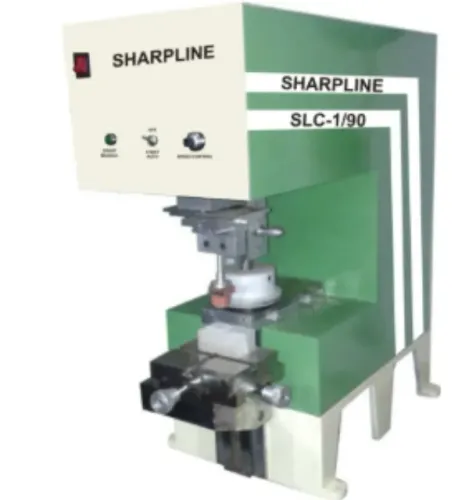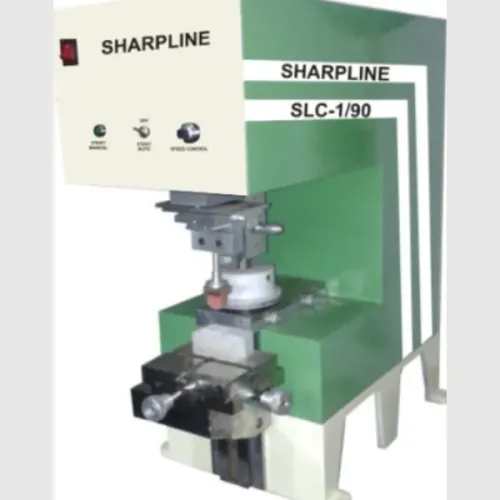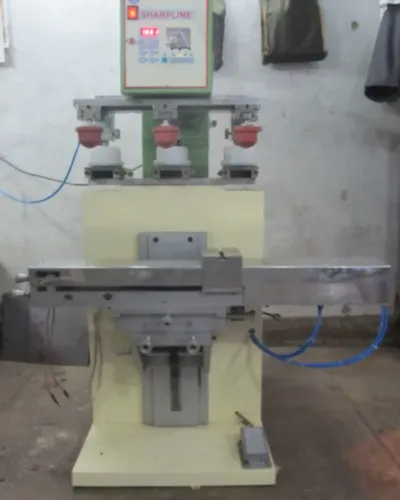

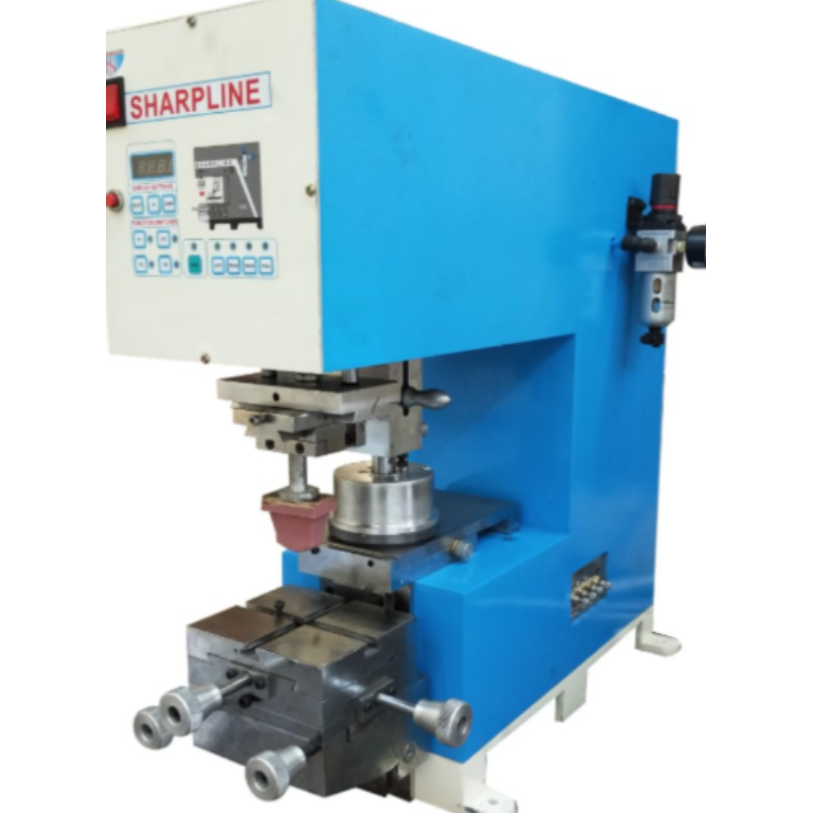
A Pneumatic Pad Printing Machine uses compressed air to control important machine movements during the printing cycle. This operating method is widely used for industrial applications where manufacturers need controlled, repeatable printing on components with flat, curved, recessed, or irregular surfaces.
Understanding how the process works can help production teams determine whether pneumatic operation is appropriate for their printing requirements.
The Basic Pad Printing Process
Pad printing is an indirect printing process. The artwork is first etched or formed on a printing plate, commonly called a cliché.
Ink fills the image area on this plate. A flexible silicone pad then picks up the inked image and transfers it onto the product.
A typical cycle includes:
- Applying ink to the cliché
- Removing excess ink from the plate surface
- Allowing the exposed ink film to become transferable
- Lowering the silicone pad onto the image
- Picking up the image
- Moving the pad toward the component
- Pressing the pad onto the printing surface
- Returning the system for the next cycle
Pneumatic controls help coordinate these movements.
Why Compressed Air Is Used
Compressed air can provide smooth and repeatable movement for mechanisms involved in pad printing.
Depending on machine design, pneumatic systems may operate pad movement, ink mechanisms, component fixtures, or other functions.
Stable air pressure is important. If the factory's compressed-air supply fluctuates considerably, machine behaviour can become less predictable. Production teams should therefore understand the recommended pressure and air-quality requirements before installation.
Where Pneumatic Machines Are Commonly Used
These machines can be suitable for many manufacturing environments, including:
- Automotive components
- Electrical switches
- Electronic housings
- Plastic moulded products
- Appliance components
- Promotional products
- Medical product components
- Packaging parts
- Tools and hardware
The key advantage of pad printing is its ability to reach surfaces that are difficult for many direct printing processes.
A silicone pad can deform around the component during image transfer, allowing printing on curved and irregular shapes.
Printing Quality Depends on More Than Air Pressure
Although pneumatic operation controls machine movement, print quality depends on the entire printing setup.
Pad shape and hardness affect image transfer. Cliché quality influences image definition. Ink selection affects adhesion and durability. Component fixtures influence positioning and repeatability.
Environmental conditions can also affect ink behaviour.
For this reason, operators troubleshooting inconsistent printing should avoid assuming that every defect originates in the pneumatic system.
Preparing the Production Area
Before installing a machine, manufacturers should assess the available compressed-air supply, electrical requirements, operator workspace, ventilation, component handling, and drying arrangements.
The equipment should also be positioned so that operators can load and unload components safely without unnecessary movement.
Companies operating in New Delhi and surrounding Delhi NCR manufacturing clusters may use pneumatic pad printing systems for both specialised batches and repetitive component marking. Local access to machine accessories and application support can also be useful when production requirements evolve.
SHARPLINE ENGINEERS manufactures pad printing equipment for industrial applications and can evaluate machine configurations according to component and printing requirements.
For manufacturers investigating pneumatic technology, the most useful approach is to study the complete application rather than the machine mechanism in isolation. Component geometry, material, artwork, output volume, fixture design, ink selection, and compressed-air conditions together determine whether the printing process will perform consistently in actual production.