A two-colour pad printer is only useful on a packaging line when its ink transfer, part location, registration and utilities match the actual container and production sequence. You will be able to map the printing process, size the machine, compare open wells with closed cups and define the supplier tests needed before approving a purchase.
Key takeaways
- Use two separate impressions, clichés, pads and ink wells for two colours.
- Fix the part in a repeatable fixture before specifying registration accuracy.
- Compare open wells with closed cups against ink consumption, cleaning and duty cycle.
- Demand a production-part trial, cycle-time figure and acceptance criteria in writing.
How two open ink wells transfer two colours
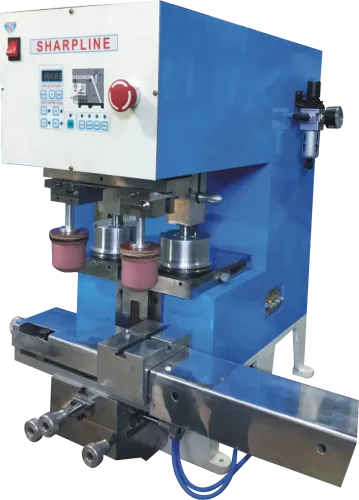
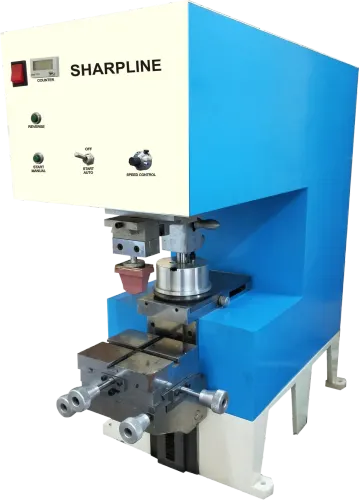
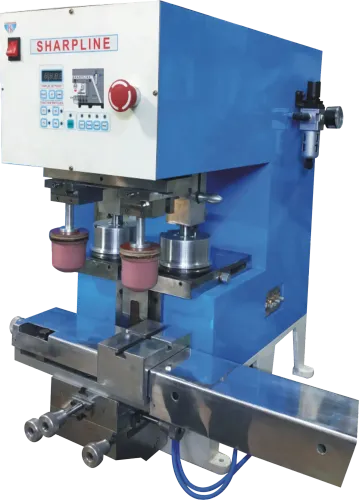
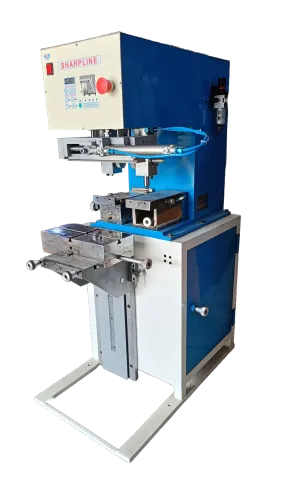
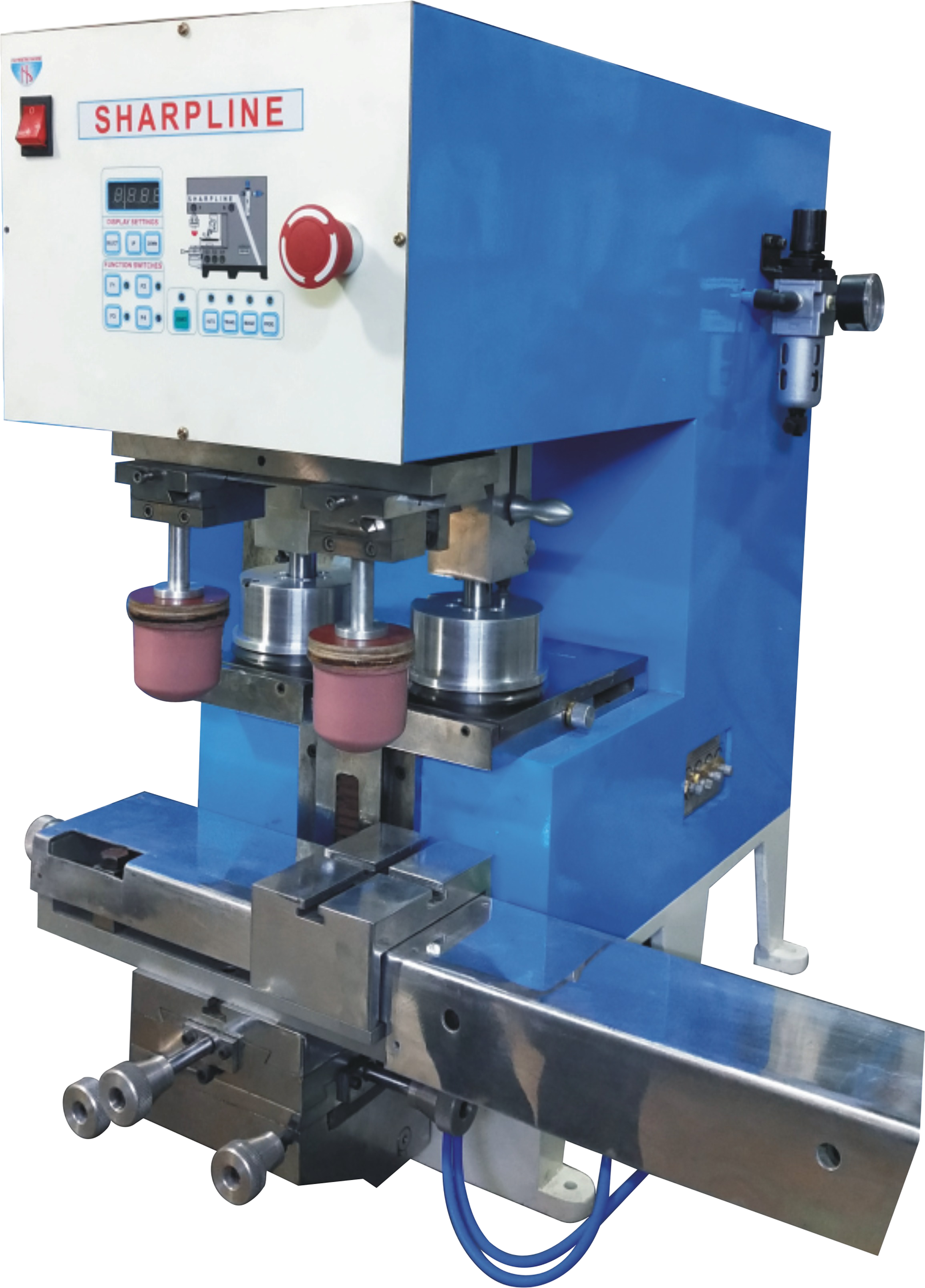
A double-color open ink well pad printing machine prints a two-colour image in two separate impressions, not in one stroke. It uses two open wells, each feeding its own etched cliché and pad. A fixture holds the packaging part in a fixed position.
The machine applies the first colour, then indexes or transfers the part before the second pad applies the other colour. Registration comes from the fixture, part-present sensor and controlled pitch, not from the word “double-colour”. If the part moves between impressions, the second mark can miss the first.
A repeatable setup fixes these process variables:
- Cliché height and etch depth, so each pad contacts the image correctly.
- Pad stroke and dwell, so the ink transfers without smearing.
- Ink flooding, which fills the etched image before transfer.
- Doctor-blade pressure, because excess pressure can damage the cliché or remove too much ink.
- The pad and fixture position, which control image registration.
An open ink well printing system leaves its ink surface exposed to air. Solvent loss increases viscosity, causes ink skinning and leaves fine cliché details partly unfilled. Control the problem with covered wells where possible, viscosity checks, solvent replenishment and a defined ink pot life.
Treat the pad, cliché, ink and packaging surface as one process set; changing the substrate can require a different ink, pad hardness, surface treatment or cliché depth.
Which packaging parts can carry a registered two-colour print?
A cap, closure, jar, tube, bottle or medical packaging component can carry a registered two-colour print only after a trial on production-equivalent parts. Check the actual surface curvature, material, texture, seam, draft angle and available print height; nominal diameter alone proves nothing.
A pad that is too flat or soft can trap air, smear the first colour or shift the second.
Establish suitability with this evidence:
- Supply the final artwork, including registration marks, minimum line width, reversed text and smallest characters.
- Print both colours in the intended sequence using the proposed cliché plates, pads, fixture and part orientation.
- Measure colour-to-colour registration at several points and record the allowed tolerance in millimetres.
- Inspect adhesion and appearance after abrasion, cleaning agents, oils, heat, sterilisation or other real packaging exposure. ASTM D3359 and ISO 2409 require controlled test conditions; do not treat their results as interchangeable.
- Confirm the fixture locates every part against the same datum and that rejects are removed when either colour falls outside tolerance.
| Part geometry | Main risk | Evidence to demand |
|---|---|---|
| Flat cap or closure | Low pad conformity | Clean edges and stable registration across the batch |
| Curved jar or bottle | Image distortion | Full artwork transferred without stretching or gaps |
| Tube shoulder or medical component | Seam, draft or limited access | No interference, smearing or concealed unprinted zones |
For food-contact packs, approve the ink, thinner and substrate against FSSAI safety and migration provisions, not merely against a packaging printing machine in India.
How to design the packaging-line sequence and specify capacity
Do not compare headline impressions per hour until you have drawn the complete process route. A packaging printing machine in India may print at its quoted rate while the feeder, curing station or inspection unit limits the line.
1. Map the sequence: loading or feeder, orientation, part-present check, nest, first-colour impression, second-colour impression, curing or drying, vision inspection, reject discharge and pack-out. Mark which stations are included in the printer quotation and which require separate equipment.
2. Define the product data: part pitch, loading method, number of cavities, print area, image height, two-colour registration tolerance in millimetres, nest repeatability, change-part time and recipe storage. Record the actual package material and production-equivalent samples.
3. Request capacity as completed good parts per minute, not only machine cycles. State the number of colours, impressions per cycle, loading efficiency, curing time, inspection decision time and planned availability; otherwise a fast two-colour cycle can produce fewer accepted packs than a slower integrated line.
4. Specify the control signals: line trigger, encoder or pitch signal, part-present confirmation, print-complete confirmation and reject output. A basic start signal cannot track variable conveyor speed or changing product pitch.
5. Confirm utilities and integration boundaries. Ask the pad printing machine manufacturer in India for packaging lines to state clean, dry air pressure and flow, electrical supply, earthing, guarding, PLC communication, automatic loading, vision, curing and reject-handling scope. Check 230 V/50 Hz or three-phase compatibility at your plant.
Compare suppliers using the same sequence, signals and acceptance rate. That turns a quoted cycle figure into a usable line capacity.
Open ink well or closed ink cup: which suits the production duty?
Choose an open arrangement when the line runs short or medium batches, an operator is already assigned to the machine, and the lower equipment cost outweighs solvent checks and cleaning time.
| Option | What it means | When it applies |
|---|---|---|
| Open ink well printing system | Exposed ink trays, doctor blades and separate colour circuits; operators monitor ink level, solvent loss, contamination and blade condition | Choose it for frequent colour changes, accessible packaging parts, supervised production and cost-sensitive lines |
| Closed ink cup system | Sealed cups meter ink against the clichés while limiting solvent evaporation and airborne contamination | Choose it for long runs, high throughput, unattended intervals, volatile inks or tight colour consistency |
A double color open ink well pad printing machine justifies its attention when the operator can record ink consumption, top up solvent correctly and clean between batches without delaying the line. Request measured ink use and cleaning minutes per changeover; a lower quoted price can disappear through labour, waste and downtime.
Choose closed cups when an exposed well would skin over, collect dust or drift in viscosity during a long run. The cup reduces exposure, but it does not remove process control: verify cup sealing, doctor-ring wear, cliché life and colour stability.
For either system, document cliché height, pad stroke and dwell, ink flooding and doctor-blade pressure. Excess pressure can damage the cliché; insufficient pressure leaves background ink and creates dirty prints. Validate the ink, thinner and substrate together, especially for food-contact packs where migration and set-off require separate compliance assessment.
What to demand in the supplier trial, quotation and acceptance test
Demand a witnessed trial on your production-equivalent parts, not a demonstration on a convenient flat sample. A pad printing machine manufacturer in India for packaging lines must prove registered colour placement, usable appearance and stable output after the same handling, drying and inspection steps your line will use.
1. Print your caps, closures, jars or tubes through both impressions. Record registration error, image dimensions, colour density and rejected parts. Test adhesion with a defined method such as ASTM D3359 or ISO 2409, then check abrasion and chemical resistance after the relevant packaging exposure; do not treat those methods as interchangeable.
2. Require a written utility schedule: compressed-air pressure and flow, air quality, electrical phase and voltage, frequency, earthing, footprint and exhaust needs. Confirm these against your factory’s 230 V/50 Hz or three-phase supply; “standard power” is not an installation specification.
3. Make the quotation separate the printer from feeder, orientation, fixture, vision inspection, curing or drying, reject handling, change parts, guarding, controls and recipe management. Ask whether the machine accepts a line trigger, encoder or pitch signal and returns part-present, print-complete and reject outputs.
4. Run a continuous trial long enough to expose ink-well attention, pad wear, registration drift, jams and operator loading delays. Put the agreed cycle rate, sample quantity, defect limit and changeover time into the acceptance test.
5. For food-contact packaging, request ink, thinner and substrate documentation covering migration and FSSAI requirements. Use the same checklist with SHARPLINE ENGINEERS or any pad printing machine manufacturer in India before comparing quotations.
Related product
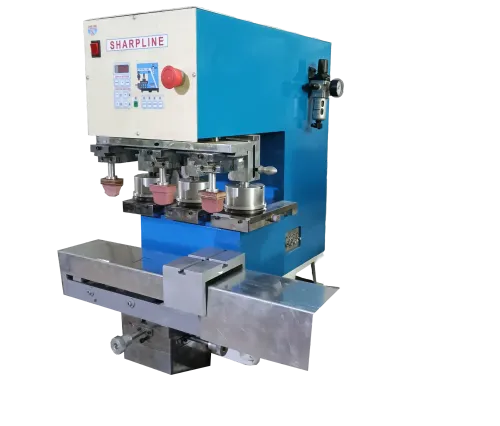
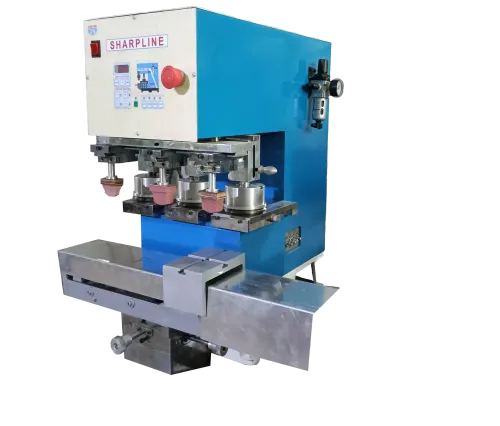
 | DOUBLE COLOR OPEN INK WELL PAD PRINTING MACHINE DOUBLE COLOR OPEN INK WELL PAD PRINTING MACHINE We are designated with a position of trustworthy suppliers involved in dealing with Double Color Open Ink well Pad Printing Machine and offering the... View product → |
Frequently asked questions
How does a double-colour open ink well pad printing machine transfer two colours?
It makes two separate pad-printing impressions. Each colour uses its own open ink well, etched cliché and pad, while the fixture keeps the packaging part in position between impressions.
Which packaging parts can carry a registered two-colour print?
Parts with a stable, clean printable surface can carry the print when the fixture controls their position. Check the surface shape, material, available print area and registration tolerance before choosing the machine.
How should you specify capacity for a packaging line?
Specify the required parts per minute, two-colour cycle sequence, loading method, changeover time, print-area dimensions, registration tolerance and inspection method. Base capacity on a trial with your actual parts and artwork.
When is an open ink well better than a closed ink cup?
Compare the production duty, ink usage, solvent exposure, cleaning time, colour changes and operator access. An open ink well suits a process that prioritises accessible ink management; a closed cup suits controlled ink exposure and reduced evaporation.
What should a supplier prove during the trial and acceptance test?
Require a trial on your packaging parts with final artwork, ink and fixture. Record parts per minute, registration result, print quality, rejection rate, changeover time and cleaning steps, then include agreed limits in the quotation and acceptance test.
Keywords