The right choice depends less on the number of colours than on how the component must be held, indexed, inspected and cured. By the end, you will be able to match the job to a standard four-colour platform or specify special-purpose modules, then compare suppliers using production evidence rather than catalogue speed.
Key takeaways
- Choose four-colour equipment when one stable print face controls production.
- Reject the target if the fixture cannot repeat part position and orientation.
- Match ink, pad hardness and curing time to the component surface.
- Demand a timed production demonstration using your parts and artwork.
Choose the machine around the production constraint
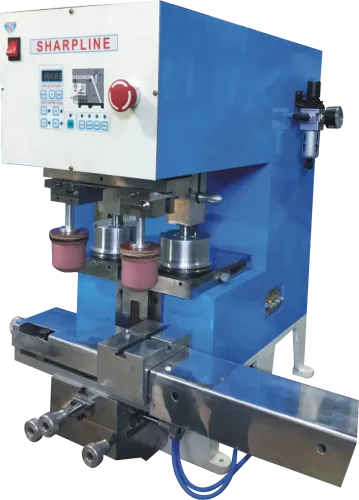
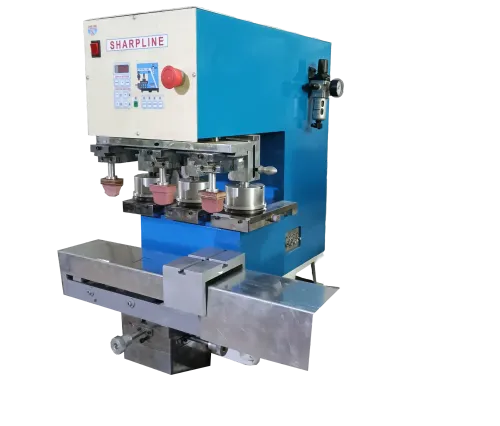
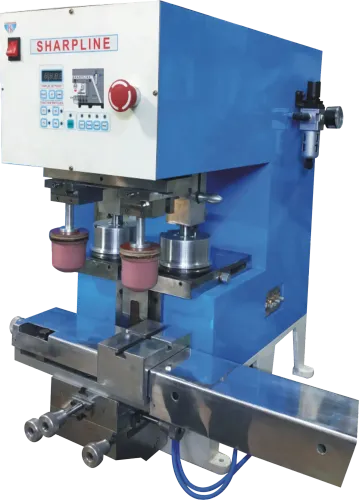
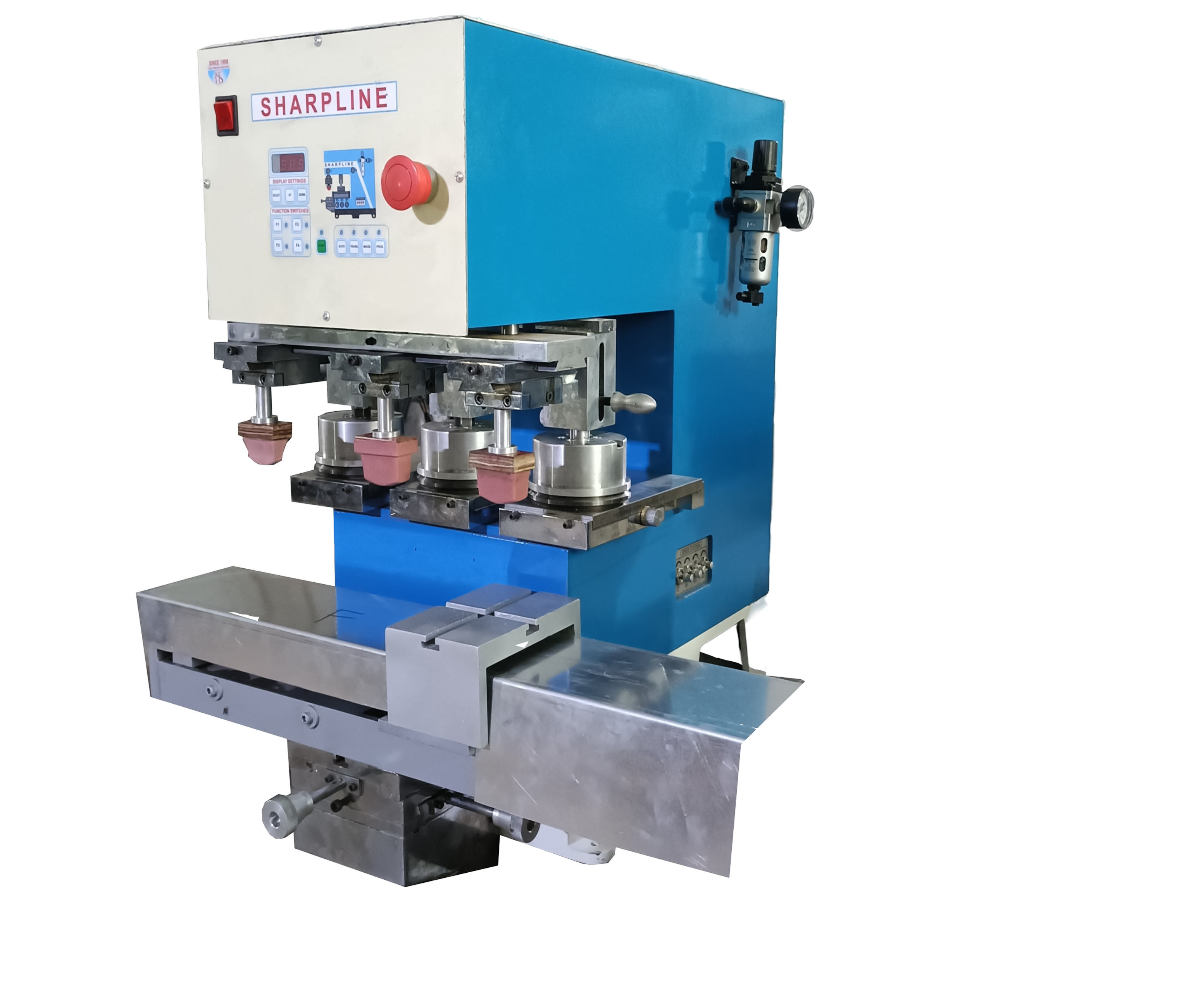
Choose four color pad printing machines when the component has an accessible, stable print face and four colours are the main production constraint. A standard platform is the lower-risk choice when volumes justify the cycle, artwork tolerances are known, and an engineered fixture can hold every part consistently.
| Option | What it solves | When it applies |
|---|---|---|
| Standard four-colour platform | Four separate transfers with fixture-based registration | One accessible face, repeatable part geometry, manual or simple automatic loading |
| Special-purpose equipment | Dedicated indexing, multi-face access, automation or inspection | Orientation, handling, curing or quality control limits output |
| Custom tooling on a standard machine | Better location without a fully custom machine | The print face is stable but the supplied fixture is not |
| Integrated special-purpose cell | Coordinated loading, printing and downstream operations | The process needs robotic loading, vision inspection, pretreatment or conveyor transfer |
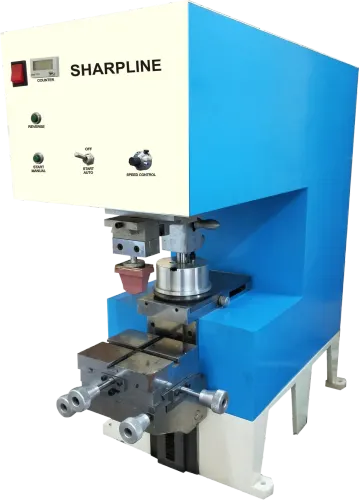
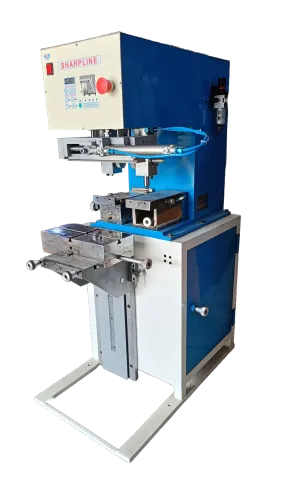
The artwork alone does not justify a special machine. Specify special purpose pad printing machines in Delhi when part handling, multiple faces, inline pretreatment, curing or vision inspection—not colour count—sets the ceiling on good parts per hour.
Do not accept the advertised cycle rate as your production figure. Four cliché engagements, indexing and pad travel reduce finished output; request sample parts printed continuously at the intended speed using the final ink, clichés, pads, fixture and cure process. Judge good parts per hour, registration drift and handling defects, not bench-test impressions.
What a four-colour production cycle must control
A visible colour shift usually begins with the part, not the artwork. Four color pad printing machines make four separate transfers, so the component must return to the same datum at every print position; a locating feature suitable for one colour can reveal drift after three further engagements.
1. Prepare one etched cliché or ink cup for each colour, with registration marks or a controlled artwork datum where practical. Set the colour sequence around ink opacity, drying time and the areas each pad must reach.
2. Load the component into a rigid fixture that prevents rotation, lift and lateral movement. Index it to the next station or hold it through four accurately spaced print positions.
3. Transfer the first colour with a silicone pad matched to the surface shape. Repeat the pick-up, travel and release cycle for the remaining colours without disturbing the part.
4. Inspect the assembled image for colour-to-colour registration, edge definition and adhesion at the required production speed. Count good finished parts, not four individual strokes.
Registration changes with fixture wear, pad deformation, cliché mounting and heat growth in the machine or component. Verify repeatability using the intended part, fixture, ink, pad and artwork rather than accepting a universal supplier tolerance.
Ink behaviour also controls the interval between transfers. Solvent-based one-component ink, two-component ink with hardener and UV-curable ink require different pot-life, drying and cleaning controls; UV ink fails in recessed or shaded areas when the delivered dose is insufficient.
Check whether the component and output target are realistic
An advertised cycle rate is not your production rate. Count good parts per hour after four cliché engagements, pad travel, indexing, colour drying and rejected parts. The component’s material, surface energy, curvature, height variation and accessible print face determine whether each transfer lands cleanly.
A worn or flexible fixture then turns small location errors into visible registration defects.
Check these production constraints before accepting the target:
- Specify cavity count and handling time. A four-cavity fixture can raise output, but loading four parts consistently may erase the gain.
- Measure the print face and lock part location with hard datum points. Fixture wear, pad deformation, cliché mounting and thermal expansion all shift registration.
- Run the intended ink, cliché, silicone pads, fixture and curing process at production speed. A short bench demonstration hides ink drying changes and handling defects.
- Confirm factory conditions for industrial pad printing equipment in Delhi: electrical supply, specified compressed-air pressure, filtration and drying, solvent exhaust, ambient temperature, and service access. Wet or unfiltered air causes uneven pneumatic motion.
| Choice | Realistic when | Main risk to good parts per hour |
|---|---|---|
| Standard four-colour platform | The print face is accessible and one engineered fixture holds every part consistently | Manual loading, reorientation and changeovers consume the nominal cycle gain |
| Special-purpose equipment | The job needs automated loading, multi-face access, vision inspection, inline pretreatment, curing or conveyor integration | Complex tooling and maintenance add downtime if the process is not stable |
| Four-colour machine with custom fixture | Artwork needs four colours but part handling is straightforward | Poor datum control creates registration rejects despite adequate machine speed |
Run a continuous sample using the proposed production batch, then record accepted parts per hour, registration drift and reject causes.
Compare ink systems, pads and operating discipline
Compare open ink-well and closed ink-cup systems by process control, not colour count or purchase price. An exposed well suits large clichés and some long print areas, but its larger ink surface increases evaporation, contamination and operator contact. A sealed cup limits solvent exposure and viscosity change, which reduces colour variation during continuous production.
| System | Process advantage | Operating cost or risk | Best comparison test |
|---|---|---|---|
| Open ink-well | Handles large clichés and flexible ink replenishment | More frequent viscosity checks, cleaning and solvent exposure | Run the intended ink at production speed and record viscosity drift |
| Closed ink-cup | Controls evaporation, contamination and operator contact | Requires compatible cups, rings and careful sealing | Check ink consumption, seal wear and print consistency across the full shift |
Do not treat the pad as a standard accessory. Match silicone hardness, shape, surface finish and travel to the part’s curvature; a soft pad may wrap around contours but deform registration, while a harder pad can leave incomplete transfer. Confirm the result using the actual cliché, fixture and ink.
For four color pad printing machines, ask for good parts per hour after all four transfers, indexing, handling and curing. Require shift records for viscosity measurement, two-component ink pot life, pad cleaning, cliché storage and end-of-shift wash-up.
These controls matter equally on special purpose pad printing machines, where automation cannot correct a dirty cliché, worn fixture or unstable ink.
Turn a supplier demonstration into a buying decision
Request a production trial, not a bench sample. The supplier must print your component at the proposed production speed using the intended ink, clichés, silicone pads, fixture and cure process. A ten-minute demonstration can hide registration drift, ink drying, pad deformation and handling damage.
1. Ask for a run report showing total cycles, colour count, cavity count, stoppages, rejects and good parts per hour. Judge four colour pad printing machines or special purpose pad printing machines in Delhi by saleable output, not the headline cycle rate.
2. Supply your actual artwork and components, then inspect registration at the beginning, middle and end of a continuous run. Request retained samples and measurements for part location, colour alignment and print adhesion.
3. Obtain a written utility and maintenance schedule covering electrical supply, compressed-air pressure and filtration, exhaust or solvent handling, ambient range, access points, pad life, cliché changes and changeover time. Wet or unfiltered air can alter pneumatic motion and registration.
4. If the proposal includes indexing, robotic loading, vision inspection, pretreatment or curing, require each module to demonstrate its fault response and recovery procedure. Ask SHARPLINE ENGINEERS to document these acceptance tests if they are supplying the line.
For industrial pad printing equipment in Delhi, make payment milestones depend on agreed good-part output and registration results on your parts. Reject a specification that gives repeatability only for a test coupon or omits the fixture, ink and operating conditions used to achieve it.
Related product
 | SPECIAL PURPOSE PAD PRINTING MACHINE SPECIAL PURPOSE PAD PRINTING MACHINE Our organization is avidly engaged in supplying an exclusive range of Plasto Special Purpose Pad Printing Machine at reasonable prices. View product → |
Frequently asked questions
When should you choose four-colour pad printing machines?
Choose them when the component has an accessible, stable print face and four colours drive the production requirement. Confirm that the artwork tolerances, volume and fixture repeatability support the cycle.
When is special-purpose pad printing equipment the better choice?
Use special-purpose equipment when the component needs unusual access, multiple faces, complex handling or a dedicated sequence that a standard four-colour platform cannot control reliably.
What must a four-colour production cycle control?
Control part loading, fixture location, pad alignment, ink transfer, colour registration, flash-off or curing time and unloading. A repeatable sequence matters more than the machine’s colour count alone.
How do you test whether the output target is realistic?
Run your actual component, artwork and ink through a timed demonstration. Check registration, rejects, drying time, operator loading time and the fixture’s repeatability at the required output.
What should you compare in ink systems and pads?
Compare ink adhesion, surface compatibility, curing method, pad shape and hardness, solvent handling and clean-up time. Select the combination that preserves registration and withstands the finished product’s use.
Keywords