A four-colour machine and a pneumatic machine are not opposing categories: one describes the number of print stations, while the other describes the drive system. By comparing colour requirements, registration, effective output, air utilities, and acceptance tests, you can specify the right equipment instead of comparing misleading catalogue labels.
Key takeaways
- Choose four colours only when artwork requires separate sequential impressions.
- Check registration across the complete machine, cliché, ink, pad, and fixture setup.
- Compare effective output and compressed-air demand, not advertised cycle speed alone.
- Run a part-specific acceptance test before selecting a Delhi supplier.
Four-colour and pneumatic describe different machine attributes
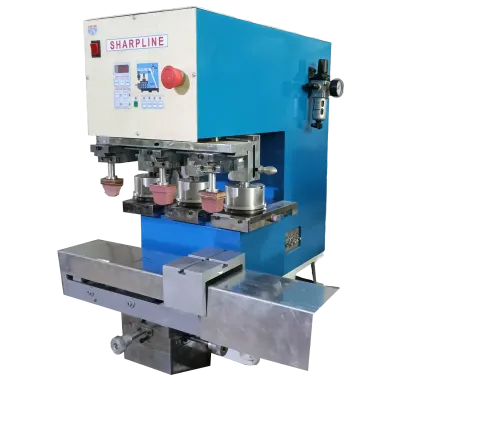
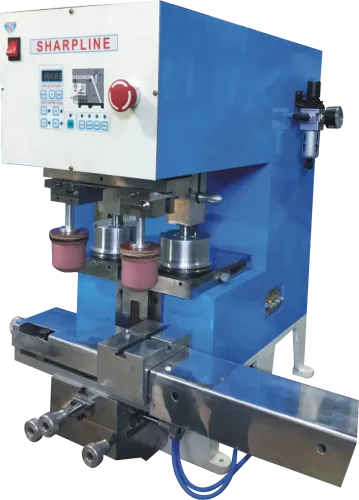
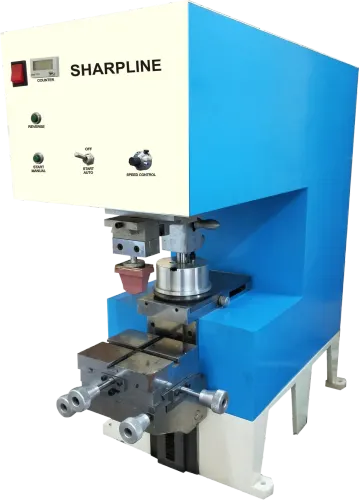
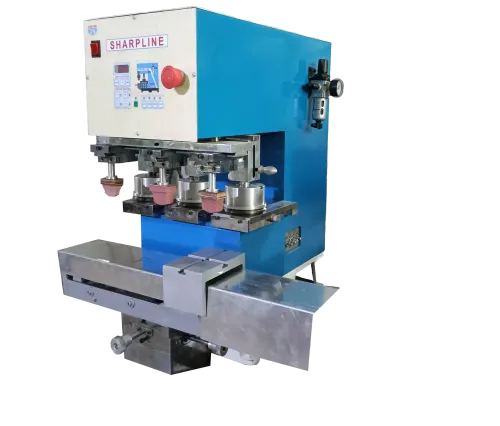
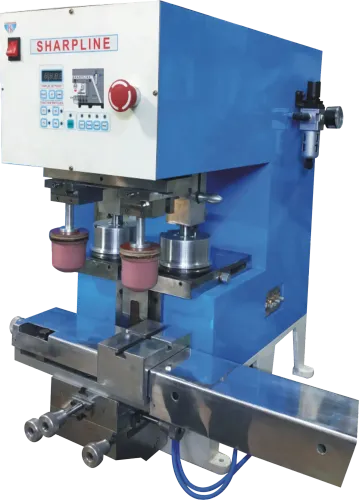
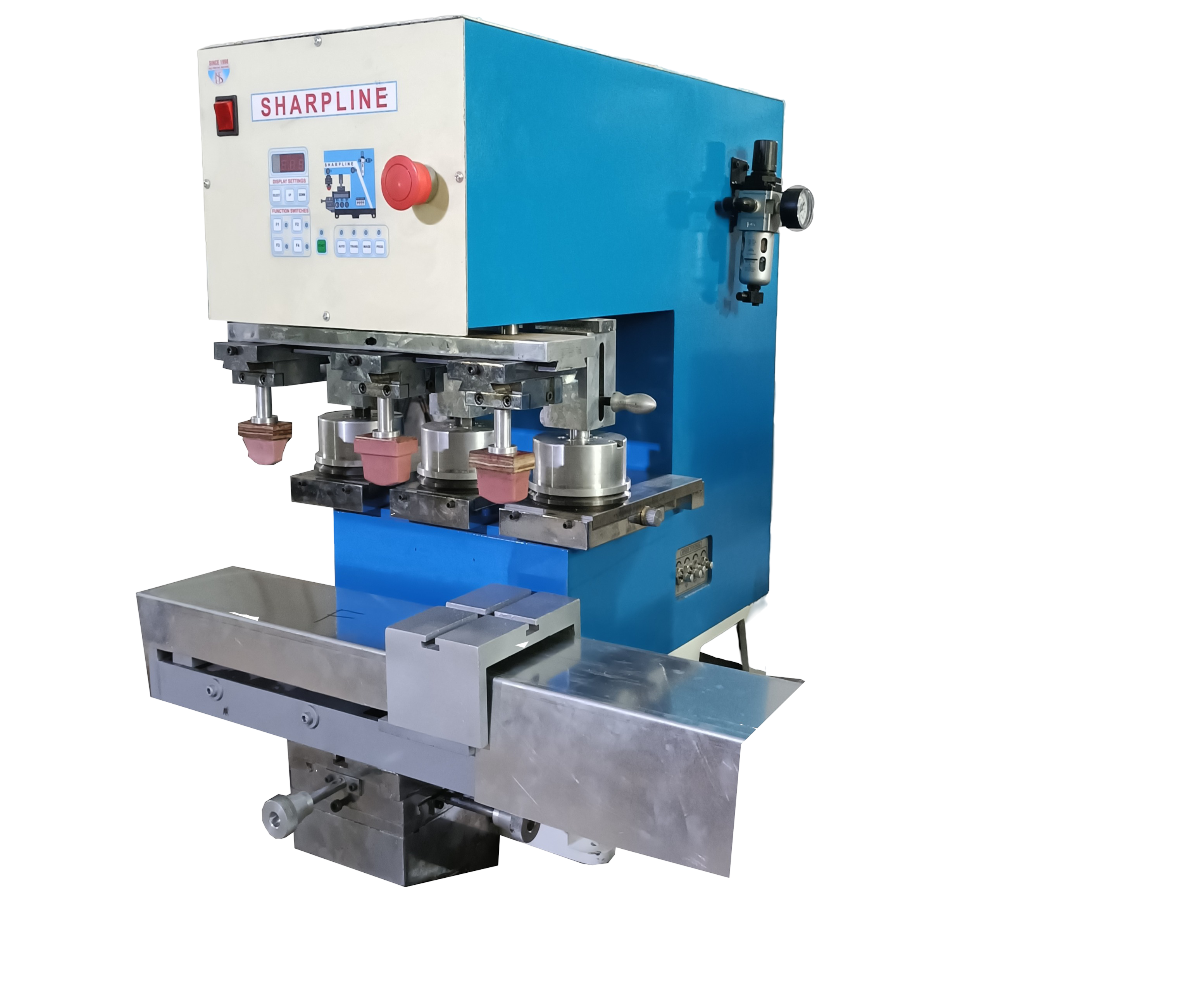
Four-colour identifies the number of print stations; pneumatic identifies the drive method. A four-colour unit can therefore be pneumatic, servo-driven, or hybrid. A pneumatic pad printing machine in Delhi may print one colour, while four color pad printing machines in Delhi may apply four inks sequentially through separate clichés, ink cups, and silicone pads.
| Attribute | Four-colour machine | Pneumatic machine |
|---|---|---|
| Meaning | Four colour stations or impressions | Pneumatic cylinders provide movement |
| Colour capability | Sequential colours; not automatically CMYK halftone reproduction | Usually one colour per cycle unless configured with multiple stations |
| Core risk | Cumulative colour-to-colour registration error | Single-pass placement and repeatability |
| Fixturing | Holds the part against rotation and lateral shift across passes | Positions the part for one impression |
| Drive comparison | Can use air, servos, or both | Uses compressed air for specified axes |
Choose four colours when the artwork requires four separate inks, such as a logo plus markings applied in sequential impressions. A single-colour pneumatic unit fits better when one ink completes the job; extra stations add setup, cleaning, alignment, and maintenance without improving that part.
Do not treat empty-cycle repeatability as proof of registration. Cliché alignment, pad travel, fixture location, substrate movement, and ink-film shrinkage accumulate between impressions. Request a trial on your component with the intended ink system, then inspect colour overlap and adhesion.
State the substrate, printable area, daily quantity, and cure method; “industrial printing machine in Delhi” is too broad.
Choose four colours when the part and artwork justify multiple impressions
Choose four colours when the artwork requires four separate ink deposits on the same part, or when repeated manual passes on a single-colour machine would slow production and increase handling errors. The advantage is controlled sequential printing through separate clichés, ink cups and silicone pads—not automatic CMYK reproduction or halftone process printing.
| Four-colour setup | Single-colour pneumatic machine | Better choice |
|---|---|---|
| Four separate colours on one component | One colour per cycle | Four-colour setup |
| Sequential logos, markings or registration points | Repeated loading and realignment | Four-colour setup |
| Simple one-colour text or symbol | One impression and unload | Single-colour pneumatic machine |
| Low volume with frequent artwork changes | Lower initial process complexity | Single-colour pneumatic machine |
Choose four-colour pad printing machines in Delhi when the part geometry, daily quantity and artwork justify a dedicated multi-impression process. A single-colour pneumatic unit remains sensible for one-colour marks, prototypes or jobs where an operator can reload the part without costly registration loss.
The fixture becomes decisive. It must stop rotation and sideways movement while supporting thin sections without distortion; otherwise an empty-cycle repeatability claim means little on the actual component. Ask for a trial using your part, four clichés, ink and pads, then inspect colour registration across a defined production run.
If the artwork needs only one deposit, the extra stations add cleaning, setup and maintenance without improving the print.
Registration depends on the complete printing process
A buyer searching for an industrial printing machine in Delhi should specify the substrate, printable area, four-colour artwork, part presentation, ink chemistry, and drying method. Without those details, a quotation cannot show whether registration will hold on the actual component.
1. Prepare every cliché from the same approved artwork file. Set the registration marks and establish one master reference, because separate artwork scaling creates cumulative colour error before the machine starts.
2. Mount and align each cliché to that reference. Check cliché-to-cliché position, ink-cup seating, pad travel, and plate height; a small offset in each station becomes visible after the fourth impression.
3. Lock the part in a fixture that prevents rotation and lateral movement without deforming thin sections. Confirm that the fixture locates against the same datums on every cycle.
4. Run the actual pad set, ink, cliché, and part at the intended cycle rate. Measure pad compression, stroke, dwell, and workpiece movement; empty-cycle repeatability does not prove colour-to-colour accuracy.
5. Control ink-film thickness and drying between impressions. Excess solvent, incorrect viscosity, or film shrinkage can shift edges even when the fixture and machine repeat correctly.
6. Inspect a defined production sample against the approved artwork. Record colour registration, print-to-print repeatability, adhesion after the specified test, first-pass yield, and rejects during the run.
Request those records in the acceptance test, not a nominal repeatability figure alone. A supplier’s demonstration on your part exposes the complete process error before you commit to equipment.
Compare effective output, air demand, and factory utilities
Request tested good parts per hour, air consumption per cycle, and total utility load before comparing machines. A four-colour unit may complete four impressions in one cycle, while a single-colour pneumatic pad printing machine in Delhi may need four separate cycles; compare finished, accepted parts, not the advertised stroke rate.
| Figure | Four-colour machine | Pneumatic single-colour machine |
|---|---|---|
| Good output | Parts per hour after all four impressions, inspection, and reject allowance | Parts per hour after repeated handling or passes |
| Cycle data | Cycle time, colour sequence, changeover time, and tested registration at that rate | Cycle time per impression, operator handling time, and repeatability |
| Compressed air | Free-air consumption per cycle at the quoted cycle rate, peak demand, and operating pressure | The same figures; 5–7 bar alone is not compressor sizing data |
| Electrical load | Voltage, phase, connected load, controller load, and any curing or drying equipment | Voltage, phase, connected load, and ancillary equipment load |
| Factory utilities | Receiver volume, regulator, filter, drain, exhaust, and floor space | Receiver volume, regulator, filter, drain, exhaust, and floor space |
Ask for free-air consumption in litres per minute or cubic metres per hour, not only cylinder pressure. Size the receiver and compressor for peak demand, then confirm voltage, phase, air quality, ink-drying requirements, and extraction.
If a quotation says only industrial printing machine in Delhi, state the substrate, daily quantity, colours, cycle rate, and cure method; otherwise its output and utility figures may describe the wrong process. Require an acceptance run on your parts and record good parts per hour, air use, rejects, and changeover time.
Use a part-specific acceptance test before choosing a Delhi supplier
Require a witnessed run on your actual component before you approve a quotation. Supply the artwork, substrate, ink, clichés, pad set, fixture, target cycle rate, and required drying or curing method; a blank test piece cannot expose movement or ink-film distortion.
Record these acceptance criteria before the trial:
- First-pass yield and total rejects during a defined production run
- Colour-to-colour registration on the finished part
- Adhesion after your specified tape, rub, solvent, or scratch test
- Print-to-print repeatability across the run
- Changeover time between jobs
- Compressed-air consumption at the agreed cycle rate
- Cleaning, pad, cliché, and ink-cup access during routine maintenance
| Test | Pass evidence | Failure signal |
|---|---|---|
| Production | Agreed quantity at target cycle rate with recorded first-pass yield | Output meets the headline rate only during short empty cycles |
| Registration | All four colours align on the actual part and fixture | Nominal machine repeatability is quoted without finished-part evidence |
| Maintenance | Operator completes changeover, cleaning, and safe access while electrical and air supplies are isolated | Residual pressure remains, or access requires improvised tools |
A four-colour setup needs a fixture that prevents rotation and lateral movement without deforming thin parts. Ask any pad printing machine supplier in Delhi to document the fixture locating method, alignment adjustments, and residual-pressure release procedure.
SHARPLINE ENGINEERS belongs in the comparison only after it records these results for the quoted four color pad printing machines in Delhi.
Related product
 | PNEUMATIC PAD PRINTING MACHINE PNEUMATIC PAD PRINTING MACHINE Single color, Non-Magnetic Tungsten carbide steel ring & compact sealed Ink cup Pad Printing machine Max. View product → |
Frequently asked questions
Are four-colour and pneumatic pad printing machines different machine types?
No. Four-colour describes the number of print stations, while pneumatic describes the drive method. A four-colour machine can use pneumatic, servo-driven, or hybrid motion.
When should you choose a four-colour pad printing machine?
Choose four colours when the part artwork requires multiple sequential impressions and the part can be positioned accurately between stations.
What determines registration accuracy in pad printing?
Registration depends on the complete process, including clichés, ink cups, silicone pads, fixtures, part location, machine motion, and curing between impressions.
What should you compare besides pad printing machine cycle speed?
Compare effective output after loading, unloading, colour changes, cleaning, rejects, compressed-air demand, electrical supply, and other factory utilities.
How should you evaluate a pad printing machine supplier in Delhi?
Give the supplier your actual part and artwork, then request a documented acceptance test covering registration, print quality, output, changeover, and utility consumption.
Keywords