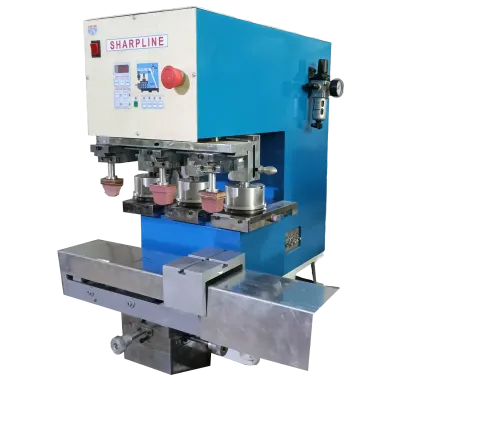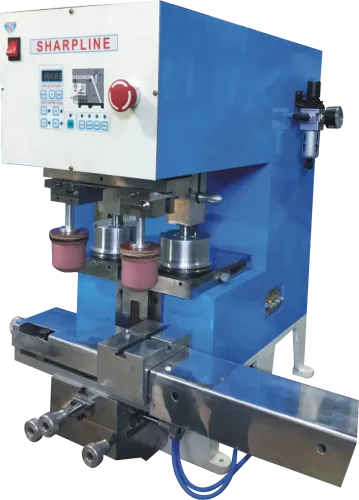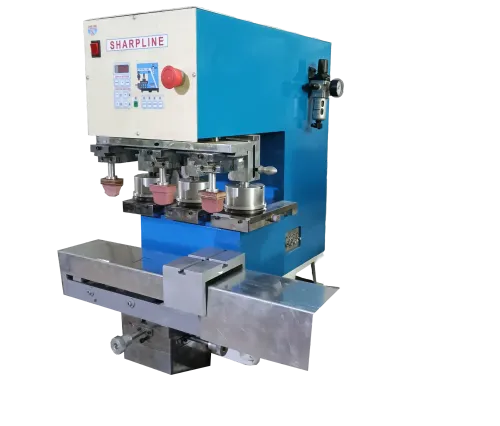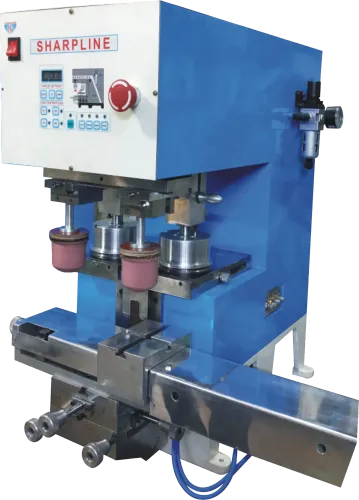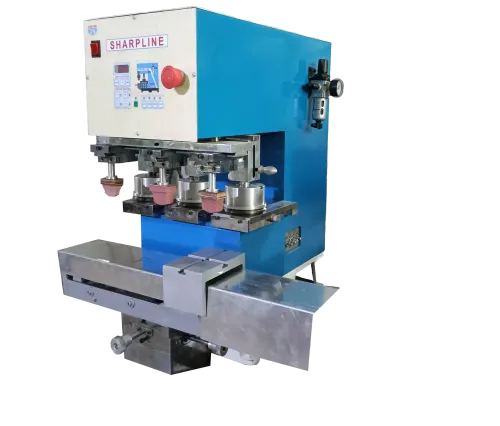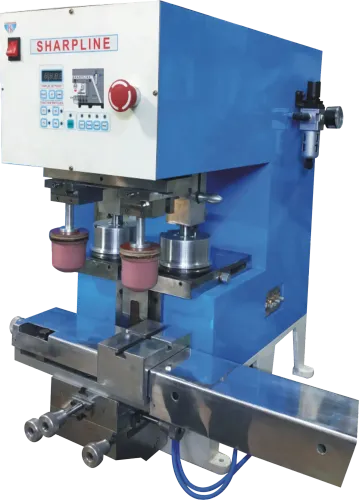
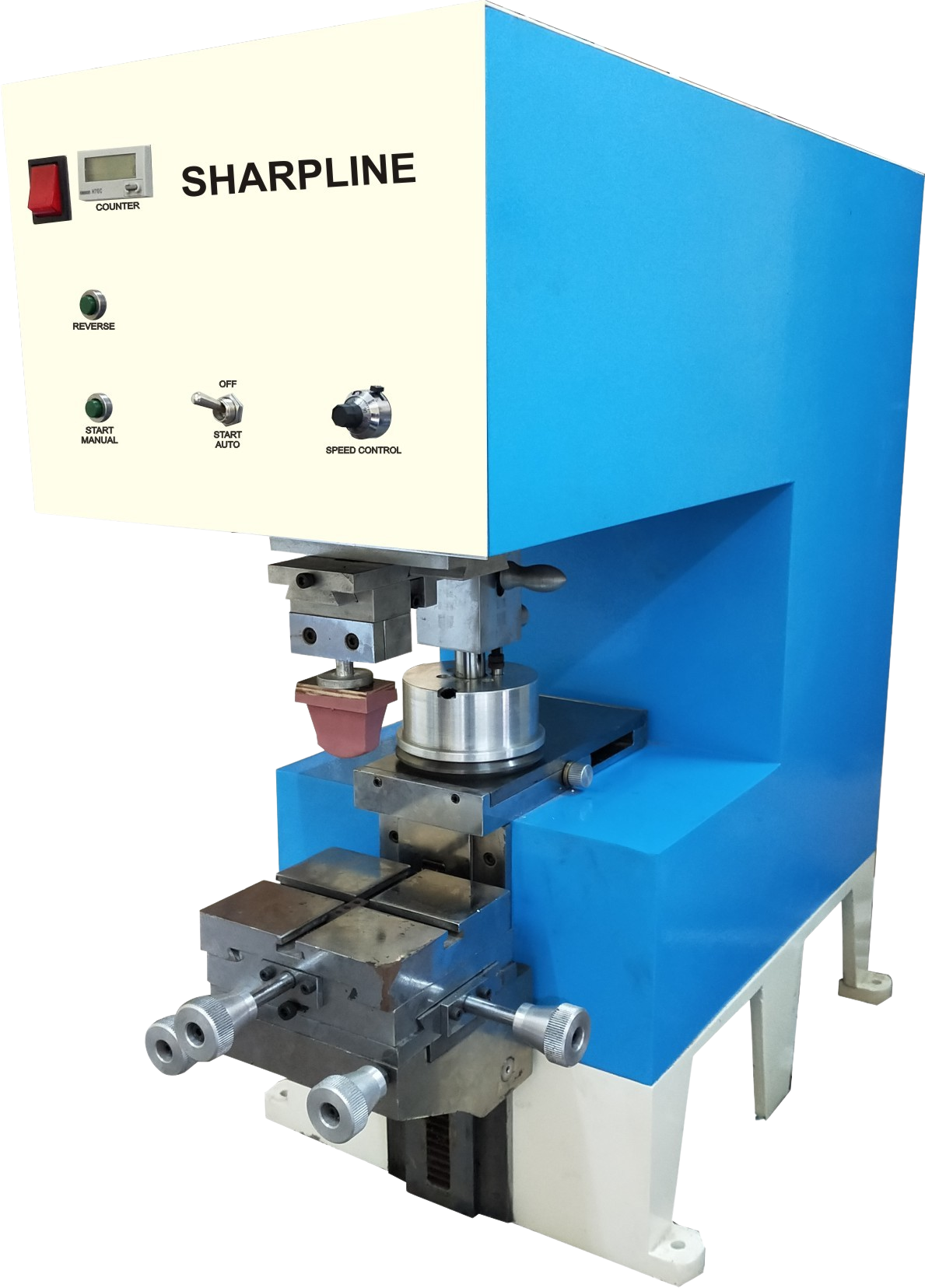
Choosing between two, three and four open-well color stations depends on more than the number of colors in the artwork. You need to match the machine’s transfer sequence, fixture and indexing method, ink-control routine, and registration capability to the part and production cycle.
Key takeaways
- Use one engraved cliché and ink path for each printed color.
- Choose open wells for accessible ink control and simpler operation.
- Match the number of colors to artwork and cycle sequence.
- Test the fixture, indexing, pad travel, and registration before purchase.
How a Two-Color Open-Well Machine Prints One Part
A double color open ink well machine transfers two separate inks through two independent color stations, not by pouring both colors into one reservoir. Each station has its own engraved cliché and ink path, so the first image remains isolated from the second.
- The first station floods ink across its cliché, removes excess ink, and loads the engraved image onto its dedicated pad.
- That pad compresses against the part and leaves the first color at the programmed position.
- A rotary index, shuttle, or repositioning fixture moves the part to the second station while preserving its orientation.
- The second station loads its own cliché image onto another pad, or onto a separate pad position, and transfers the second color.
- The machine completes both impressions in one cycle only if its indexing system and pad positions support automatic sequential transfer.
The colors do not mix because each transfer uses a separate ink supply and controlled contact sequence. Mixing can still occur if a pad touches the wrong cliché, the part shifts between impressions, or wet ink receives excessive compression.
A multi color open ink well pad printing setup therefore needs repeatable fixturing, stable pad travel, consistent compression, and controlled dwell between transfers. Confirm that the stated two-color capacity means two automatic impressions in one cycle; some equipment requires manual unloading and reloading between colors.
Open Wells Versus Closed Cups: Compare the Operating Trade-Offs
A double color open ink well machine is the better operational choice when you change colors or clichés frequently, need direct visual access to the ink, and can assign an operator to monitor the wells during production. It suits short and medium runs where quick access matters more than sealed-ink convenience.
A multi color pad printing machine open ink for well configuration exposes each ink reservoir to air, so solvent evaporates during the shift. The operator must check viscosity, remove skin or dust, replenish ink, and clean the well and doctoring hardware before buildup affects print quality.
| Option | Operating advantage | Operating cost or risk |
|---|---|---|
| Open wells | Fast ink access, simple visual checks, and quicker color or cliché changes | Solvent loss, viscosity drift, skin formation, contamination, and more hands-on cleaning |
| Closed cups | Sealed ink reduces evaporation and keeps the ink cleaner during long runs | Cup filling, sealing, removal, and cleaning add setup work; changing colors takes longer |
| Open wells | Easy access for frequent adjustments and small batches | Ink exposure increases monitoring and waste when production pauses |
| Closed cups | Stable ink condition for extended repetitive production | Less convenient when artwork or color changes are frequent |
Choose the open system when short setup changes outweigh hourly ink maintenance. Choose closed cups for long, unattended runs in dusty environments or where consistent viscosity matters more than rapid access.
Confirm that the double color open ink well machine has two independent wells, clichés, pads, and transfer positions. Otherwise, “two color” may mean manual reloading between impressions rather than two deposits in one cycle.
Choose Two, Three or Four Colors by Artwork and Cycle Design
Choose two stations for two separate solid colors when each color has its own print area and the part can index reliably between impressions.
A multi color open ink well pad printing setup needs an independent cliché, ink well, doctoring arrangement and pad position for each color; confirm that both transfers occur in one cycle rather than requiring manual reloading.
| Artwork and cycle | Select | Why |
|---|---|---|
| Two solid colors in separate areas | Two stations | The simplest layout; separate pads prevent the inks from sharing a transfer surface. |
| One color overprinted onto another | Two stations | Use a defined sequence, sufficient ink flash-off and a fixture that holds the same print location between transfers. Add stations only for extra layers or separate artwork positions. |
| Three or four separated solid colors | Three or four stations | Match the station count to the number of independent color separations printed in one cycle. |
| Registration-critical logos, gradients or fine multicolor detail | Three or four stations | More stations reduce handling and reloading, but repeatable indexing and pad travel matter more than the color count. |
Do not select four colors simply because the artwork contains four inks. If two colors share a tight boundary, the nest, rotary index or shuttle must return the part to the same datum after every impression; otherwise a four-station machine will reproduce misregistration faster.
Confirm usable pad positions, not only the advertised color capacity, and require a sample run against measured registration limits.
Control Ink, Pads and Registration Across Color Stations
Color-to-color registration depends on repeatable fixturing, controlled pad travel, equal compression, and fixed timing between stations—not stroke accuracy alone. In multi color open ink well pad printing, give each color its own cliché, reservoir, doctoring path and pad position.
Index the part positively before the second impression, then hold it still through pad contact and release.
Use these controls during setup:
- Match pad hardness and shape to the artwork; excessive compression spreads edges and transfers ink onto unintended areas.
- Set the pad’s vertical dwell and compression consistently. A fast lift can smear wet ink, while excessive dwell distorts the first deposit.
- Allow enough flash-off time between colors for the first layer to lose surface tack without drying beyond adhesion.
- Measure ink viscosity at defined intervals and clean partially cured ink from wells, blades and clichés before it flakes into the print.
- Keep each open well covered or replenished in small amounts during pauses to limit solvent loss and viscosity drift.
In a multi color pad printing machine open ink for well configuration, verify these controls by station:
| Control | Set or verify | Failure prevented |
|---|---|---|
| Part indexing | Mechanical stop or servo position repeatability | Color offset |
| Pad travel | Fixed stroke, speed and compression | Smearing and uneven edges |
| Ink condition | Viscosity check and separate tools | Contamination |
| Station timing | Consistent gap between impressions | Poor adhesion or registration |
Require a production-length sample, not one attractive part. Check registration, edge definition, pinholes, smearing and adhesion after the intended cure.
Specify the Fixture, Indexing System and Supplier Trial
A fixture must locate the part from the same datums on every cycle, not merely hold it in place. Check support under thin walls, clearance for pad compression, loading direction, and the complete part-fixture envelope. A loose nest creates registration drift that no indexing adjustment can correct.
Specify these points before comparing machines:
- Maximum image area, number of independent color stations, usable pad positions, cliché length, width and thickness.
- Pad stroke, vertical and horizontal adjustment, and clearance between pad, cliché and part.
- Rotary or shuttle repeatability, stated in millimetres, plus whether every color prints in one cycle without manual reloading.
- Ink-well dimensions, doctor-blade arrangement and access for cleaning.
- Independent speed and dwell adjustment for each transfer, rather than one shared setting.
A rotary table suits repeatable loading around fixed stations; a shuttle suits simpler access and shorter tooling, but its return position must remain stable under production speed.
Check the sample run against written limits, not a single attractive print.
| Criterion | What to verify | Failure consequence |
|---|---|---|
| Registration | Color-to-color error on the actual artwork | Misaligned outlines or overprint |
| Edge definition | Fine characters, corners and small gaps | Blurred or filled details |
| Surface quality | Pinholes, smearing and skips | Rejects after curing |
| Durability | Adhesion after the intended cure | Ink lifts in use |
| Repeatability | Results across a production-length run | Stable first part, poor later parts |
Give the open ink well pad printing machine supplier your actual parts, artwork, substrate, color standard, print area, rate and cure method. SHARPLINE ENGINEERS should document those acceptance results before you approve the machine.
Related product
 | DOUBLE COLOR OPEN INK WELL PAD PRINTING MACHINE DOUBLE COLOR OPEN INK WELL PAD PRINTING MACHINE We are designated with a position of trustworthy suppliers involved in dealing with Double Color Open Ink well Pad Printing Machine and offering the... View product → |
Frequently asked questions
How does a two-color open-well pad printing machine print one part?
It uses two independent color stations, each with its own engraved cliché and ink path. The first station transfers one image before the second applies the next color.
What is the difference between open ink wells and closed ink cups?
Open wells provide direct access to the ink and ink path, while closed cups enclose the ink against the cliché. Compare operator access, ink control, cleaning, and production requirements.
How do you choose between two, three, and four color stations?
Count the separate colors in the artwork, then check the order and timing required to print each image without interference.
What should you specify before requesting a supplier trial?
Provide the part geometry, artwork, ink requirements, fixture concept, indexing method, pad arrangement, and registration tolerance. Use the trial to verify transfer quality and station alignment.
Keywords